

How to Water New Zoysia Sod in Texas: A Complete Week-by-Week Schedule
New Zoysia sod needs more water in its first four weeks than it will need for the rest of its life. The establishment phase is when a new lawn is most vulnerable, and getting the watering schedule right during this window determines whether your sod roots successfully or stresses and fails.
The schedule below is the same guidance ZoysiaSod.com provides to every customer after a new installation. It is built around real North Texas conditions, not generic national recommendations.
Why New Sod Watering Is Different from an Established Lawn
An established Zoysia lawn has a deep root system that accesses moisture at multiple soil depths. A newly installed Zoysia sod piece has shallow roots that need to grow down into your prepared soil over the first four to six weeks. Until those roots establish, the sod is entirely dependent on surface moisture to survive.
The sod itself will dry out faster than you expect. The cut pieces do not have the root depth to pull moisture from deep in the soil. They are essentially functioning like a cut plant in a container that needs frequent watering until it roots into the ground. Understanding this is the key to getting the watering schedule right.
Additionally, North Texas conditions vary significantly between spring and summer installations. A sod install in April faces different challenges than one in July. The schedule below is divided accordingly.
New Zoysia Sod Watering Schedule: Spring Installation (March through May)
Weeks 1 and 2: Twice Daily Watering
Water twice per day during the first two weeks after a spring installation. Morning watering around 6 to 7 a.m. is the first session. A second watering in early afternoon, around noon to 1 p.m., keeps the sod surface moist during the warmest hours.
The goal for each watering session is to wet the sod completely and keep the underlying soil moist to a depth of 3 inches. Check by lifting a corner of the sod and pressing your finger into the soil beneath. It should feel wet, not just damp.
Do not water in the late afternoon or evening. Nighttime moisture on the leaf surface is the primary trigger for fungal disease. Morning watering allows the leaf surface to dry before night temperatures drop.
Weeks 3 and 4: Once Daily Watering
By week 3 of a spring installation, the roots are beginning to establish and the sod no longer needs twice-daily watering. Reduce to once per day, watering in the morning only.
How do you know the roots are establishing? Gently tug on a corner of the sod. Resistance indicates roots are anchoring into the soil. If the sod lifts easily with minimal tension, continue twice-daily watering for a few additional days.
The single daily watering session should be deep, wetting the soil to 3 inches rather than a short, shallow cycle.
Rest of First Season: 3 Times Per Week
Once the sod has rooted firmly (typically 4 to 6 weeks after installation), reduce watering to 3 times per week. The goal now is to encourage deep root growth by allowing the upper soil layers to dry slightly between irrigation cycles. Deep, infrequent watering trains roots to go deeper, producing the drought tolerance Zoysia is known for.
New Zoysia Sod Watering Schedule: Summer Installation (June through August)
Summer installations in Texas require more aggressive watering in the first month due to the combination of heat, solar intensity, and low relative humidity that causes rapid moisture loss.
Weeks 1 and 2: Three Times Daily
Install in the morning if possible. Water within two hours of installation, before heat stress can set in. During the first two weeks of a summer installation, water three times per day: early morning (6 to 7 a.m.), midday (noon to 1 p.m.), and early afternoon (3 to 4 p.m.). The third watering prevents the sod from wilting during the hottest part of the Texas summer afternoon.
Monitor the sod edges and any thin spots more closely. These dry out fastest and may show stress before the center sections of the lawn.
Weeks 3 and 4: Twice Daily
Once roots begin to establish in a summer installation, reduce to twice daily watering: morning and early afternoon. Continue checking for rooting progress by testing resistance when you tug the sod.
Rest of First Season: 3 Times Per Week
Same transition as a spring installation: once fully rooted, reduce to 3 deep irrigation cycles per week. Continue deep watering over short, frequent sessions to train roots downward.
Sprinkler System Considerations for New Zoysia Sod
If you have a sprinkler system, there are two important technical points to address for your new sod watering schedule:
Pop-ups and Rotors Run on Separate Zones
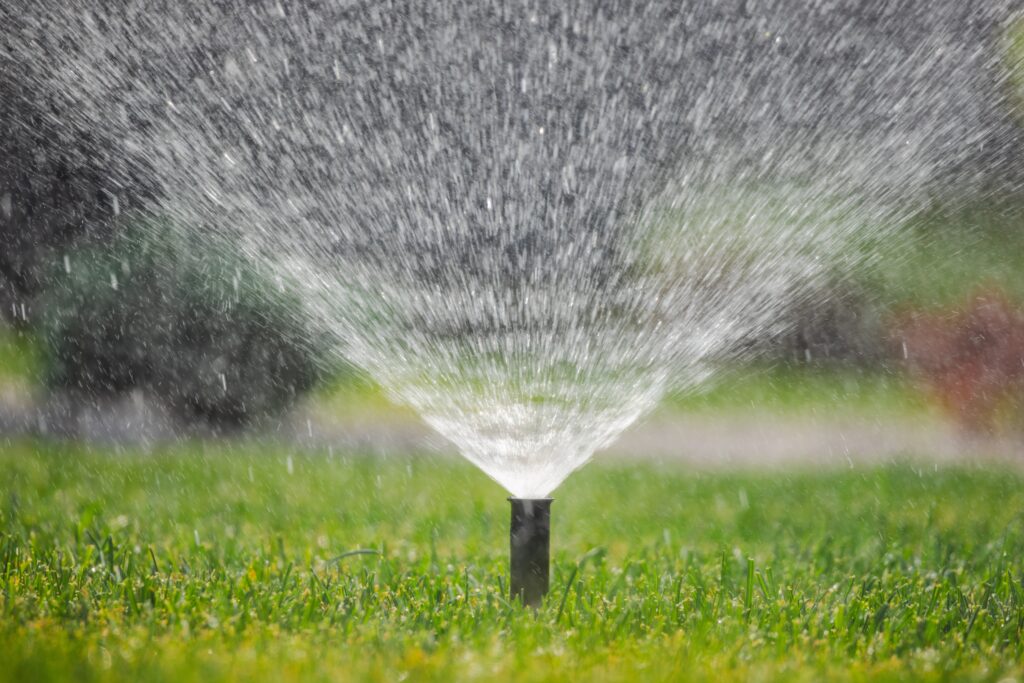
Pop-up sprinkler heads and rotor heads need to run on different zones and for different durations. Pop-up heads should run for 10 to 12 minutes per session. Rotor heads require 15 to 20 minutes per session to apply the same volume of water. Running them together on the same zone produces either overwatering on the pop-up areas or underwatering on the rotor areas.
If your system does not already separate pop-ups and rotors onto different zones, talk to your irrigation technician before your sod is installed. Getting this right before installation is significantly easier than after.
Sprinkler Head Height Adjustment
After your new sod is laid and the grade changes slightly from the compacted soil surface, sprinkler heads may sit too low relative to the new turf surface. A head that sits below the turf surface has its spray arc interrupted by the grass blades. Have your irrigation technician verify head heights after installation and adjust as needed.
A low-set sprinkler head also has a shortened service life because the extension neck makes contact with the soil surface during operation, causing premature wear and the head getting stuck in the extended position. Correct head heights extend the life of your irrigation equipment and improve coverage efficiency.
Signs of Overwatering and Underwatering New Zoysia Sod
Signs of Underwatering
- Sod edges curling upward
- Grass blades folding lengthwise (a stress response to water loss)
- Gray-green or blue-gray tint to the surface color
- Footprints staying visible for extended periods after foot traffic (slow spring-back indicates water stress)
Signs of Overwatering
- Sod sitting in standing water
- Muddy, spongy soil feel when walking on the sod
- Yellow patches or mushroom growth appearing in the lawn
- Sod that refuses to root despite weeks on the ground (saturated soil prevents air penetration and root development)
Transitioning to Normal Zoysia Watering After Establishment
Once your Zoysia lawn is fully established, typically 6 to 8 weeks after installation depending on season, the watering story changes significantly. Established Zoysia is one of the most drought-tolerant warm-season grasses available for North Texas conditions.
Palisades Zoysia needs only one to two deep irrigations per month during extremely dry periods once established. Zeon Zoysia is similarly efficient. The root systems both varieties develop allow them to access moisture at depths that shallow-rooted grasses like Bermuda cannot reach.
Water deeply and infrequently. The standard is 1 inch of water per week through the growing season, applied in one or two sessions rather than daily. This produces the deep root system that makes Zoysia drought-tolerant, rather than the shallow, moisture-dependent root system that daily watering produces.
Questions About Your New Zoysia Lawn?
ZoysiaSod.com has been installing Zeon Zoysia and Palisades Zoysia across the Dallas-Fort Worth area since 2005. We walk every customer through post-installation care including watering, mowing, and fertilization at the completion of every project. Our work is backed by a written guarantee at zoysiasod.com/guarantee, and we are available to answer questions after your installation. If you are planning a new Zoysia installation, get a free satellite estimate at zoysiasod.com/quote and receive a project budget within 24 hours. Call 469-802-0424 with any questions about your new or existing Zoysia lawn.